Wednesday, November 21, 2012

National Novel Writing Month

Photo by jjpacres
Being in a writing program during the fall can be an interesting time. During Halloween, you get to see costumes inspired by classmates favorites characters in literature. Outside of classes, you notice how many people don't understand these costumes and decide that next year you will be a little more mainstream.

The other amazing thing about being among writers in the fall is because of November's National Novel Writing Month. Although some people use the website to help keep them accountable, it is entirely feasible for those with intense discipline to go at this task on our own. If we were to boil it down to its most basic form, the challenge is to write 50,000 words of fiction (or more) during the month of November.

I had plans to participate, but found myself falling behind on everything and instead decided to focus on smaller, individual writing projects. Even if, like me, you failed to even begin your NaNo Writing Month, it isn't too late to get something started.

Sunday, October 21, 2012

Join a Book Club

I am going to continue posting 1-2 times per week, but in an attempt to keep myself reading I am going to commit to writing a book review once a month. I already have a reading list, but if anyone has any suggestions feel free to leave them in the comments and I'll add them on.

Joining a book club, or creating a fake online one, can help motivate and remind us that, as writers, it is important that we keep up with our reading. When we are accountable, we tend to have much better follow through. Wish me luck on my attempt to break away from solely academic reading and trying to insert some that I choose on my own.

Monday, October 15, 2012

Network

Photo by futureshape
It can be very intimidating introducing yourself to someone new, especially if the person is someone who you look up to. Recently I watched a video of a talk given by a social psychologist. In her talk, she spoke about faking it until you become it. While many of us get nervous to network, it would benefit all of us to just pretend that we are not. Eventually, as the psychologist said, you will begin to realize that you are no longer faking your confidence, but that you have actually become confident.

Networking is important in any profession, but writers should take special interest in the people around them. Writers are used for many things and you never know what kind of response you will get if you put yourself out there. Sometimes it is just the word itself that holds some anxiety for people, but an easier way to get a handle on this anxiety is just to realize that all you are doing is having a conversation. Get to know the person. Chances are that if you find some common ground they might want you in their network of contacts as well. And if they don't, who cares? All you can do is give it a shot and see what will happen. 

So the next time you run into someone who you find could prove to be an interesting contact for you to have, introduce yourself and be friendly. Making a good first impression can make networking simple and fun. Just make sure that you have anything you might need handy in case the person wants samples of your work emailed to them. And make sure to keep in touch. 

Wednesday, October 10, 2012

Write Your First White Paper

Photo by Zach Klein
In my persuasive writing class we just wrapped up a section on writing white papers. Over the past few weeks, we spent time reading white papers on white papers, making fun of poorly designed white papers from design companies, and learning how to strike a balance of being persuasive while not coming off as a car salesman. While all these things surely helped when it came to time writing our own, it wasn't until the writing process started that I realized just how much goes into writing and designing a solid white paper. Here are some of the basics:
  1. Research - This seems obvious, but depending on the product or service you will be writing your white paper on, this can be very time consuming. If your product, for example, has been around for decades, think about the wealth of material you should be reading through to get a full concept of what you should be focusing on. You may have to interview people or read old white papers to get a sense of what the company has used in the past and what they may need moving forward.
  2. Layout - I would recommend taking pencil to paper for this one. You do not want to open up InDesign or Illustrator and start experimenting with different layouts. Even if you just take the time to do a mock up of the first couple pages of your white paper, this will at least give you an idea of where you want to go and help in keeping things consistent. 
  3. Design - There are many design questions that you have to think about before starting your white paper. Are the colors you have chosen complimentary or do they clash? Is the text easy to read? Does the typeface reflect the feeling of the product you are talking about? Do you have enough images, graphs, pull-out quotes, etc.?
  4. Content - Perhaps it would be best to start this part in Microsoft Word and then transfer it into Adobe to prevent spelling and grammatical mishaps. In general, however, content is tricky because you are often challenged by fitting the hundreds of pages of research you (should) have done into a roughly ten-page format while still being creative. Choosing what to highlight can be daunting, but try to think of the information that best suites the audience to whom you are tailoring your white paper.
  5. Revision - This goes without saying, but all work needs revision. After the fourth or fifth run-through you may find a glaring grammatical issue that had previously escaped you. Maybe on round six you notice that the alignment is off on the last page. Of course, eventually the white paper has to be finalized, but if you have the time for one more revision, take it. 
While the white paper I have written was intended for academic purposes, I contacted the company to receive permission to use photos, quotes, and content to create the white paper so that I could include it in my professional portfolio. I even offered that they be able to see it once completed. Although it was my first time writing a white paper, I felt that the experience was a beneficial one. Being able to write a white paper is a great skill for any writer to have in their wheelhouse. I recently contacted an old job asking if they had any need for a white paper and they said that they had just been discussing it. If I can land just one project and really impress, then maybe it will become a skill that I can use in the long term.

For now, if you have any interest in practicing your white paper skills, I would start by Googling "white paper" and see what comes up. Look through a couple examples and see what types of articles people are writing. With some determination, this is definitely something that any good writer can learn. 

Sunday, October 7, 2012

Make Friends

“A good writer possesses not only his own spirit but also the spirit of his friends.”
― Friedrich Nietzsche
Whoever said writing was a solo endeavor was very (very) wrong. He or she also probably wasn't a highly revered philosopher, like Nietzsche, who actually spent time thinking of such things. Whenever we see writers portrayed on television or in the movies it often seems as though they are the typical loner-type. They always seem to be brooding, depressed, and having some kind of relationship issue. While this may be true of some writers, it shouldn't be looked at as a hard and fast rule. In fact, many of us are pretty social people who need contact with others to balance out the time we spend (alone) writing our work.

I came to realize this very important factor when I moved to Atlanta last month. Back home, I had many friends that I could really just go have fun with. This gave me a brief, but needed, reprieve from writing. I also had my "writing friends" who I could call whenever I was in a rut or needing a little pep talk. I even had a couple friends that I could swap work with for some editing and content suggestions (highly recommended). I never realized how pivotal a role all these people played in my writing. Although they were not involved in the direct process of my writing, in a very essential way, they played a key role in my success as a writer. I suppose it was just something I hadn't realized until it was gone.

Thankfully, I am still friends with all these people. My change in location, however, has provided me with some unique obstacles to my writing. Although my close friends are a phone call away, I find myself having too much time with myself (if that makes any sense) and I'm finding that I am past due on making some geographically suitable friends, writers and otherwise. So (this is really more advice to myself than anyone else) go make some friends, appreciate the ones you have, and always remember that writing is so much more than the time you spend in front of your computer, typewriter, or notebook. Don't be that loner writer that looks down as they walk. Say hello to a passerby, they could inspire you to write something new or be the reason that you are able to finish something that has been waiting for its time in the sun.

Your friend,
Jonathan


Find Your Space

Photo by Leon Hart
Currently, I find myself doing most of my writing in a library. This isn't the first place that comes to mind when I think about ideal spaces for my writing, but it does have its benefits. My ideal writing space would be dimly lit, quiet, isolated, and have a window view of Mt. Hood during March in Oregon (not to be overly specific). Instead, I find myself in a cubicle in a library in Atlanta which, although somewhat quiet and isolated, is nowhere near my snow-capped mountain.

With these limitations, how can a writer find their space? I've come to learn that although a writer's physical space can be important, what is more important is how one enters into the act of writing. I would liken it to a type of meditation. In this sense, finding your space becomes less about what is all around you and more about what is inside you. Yes, certain situations may not be conducive to writing (especially if you are like me and can't focus around loud noise), but as writers we have the ability to transcend the physical and enter into the world of our work.

Oftentimes, my best pieces are written and I have no recollection because I was so inside my story that nothing else around me existed. It was in these moments that I found my space. The question then becomes not what your space is, but how you get there. For me, I usually find myself transported through music, art, inspirational quotes or some earplugs. Try some different things and see what works best. When you have been writing for hours on end and it seems like minutes then maybe you should retrace your steps and figure out how you enacted that writing session.

Repeat, review, and revise as needed.

Tuesday, October 2, 2012

Be Well Read


“If you don't have time to read, you don't have the time (or the tools) to write. Simple as that.”
― Stephen King

Photo by Horia Varlan
There was a time that I thought that reading and writing were two important, but separate, parts of the same puzzle. I used to think that reading too much would negatively impact my writing, that I would begin to lose my voice and unintentionally mimic the voices of the books which I chose to read. Although my views have changed slightly, I do feel that there is some truth to this. It is hard to not be influenced by the things we watch, read or experience, but with reading comes an awareness that my separate but equal theory discounted.

In my earlier stories I remember sitting for hours and brainstorming. I would write all my ideas in a journal and start to flesh out the themes and topics that I wished to explore. After brainstorming, I'd pick the idea that was most relevant to me at the moment and start to write. Usually, I would let the theme guide the story. I never had a distinct plot laid out or any specific idea for characters. I would think about what I had chosen and begin to write a scenario that seemed to fit. After hours of writing, editing, editing, and editing, I finished a draft that I thought was pretty good (and original). I was proud of the work I had done.

There would eventually come a time that I would get to share these stories, whether among friends, family or in workshops and each time I got the same response, "Oh, have you seen/read/heard of work xyz? This really reminds me of that!" This is the exact thing I was trying to avoid, but by purposely trying to maintain my voice as a writer I had also fallen into the trap of retelling a story that someone else had already told. Now, some might argue that all good stories have been told already, but by being aware of these stories writers are given a choice: do we accept the archetypes that have been set up for us or do we change them enough to make our story unique? 

When a writer is well-read there is a consciousness about the choices being made in a work. A writer can see their story from the perspective of a fellow reader and ask themselves how to escape convention and be a true original. While a well-read writer may have to find their own voice among the many others they have encountered, they have the added benefit of knowing what has been done before, so they don't waste their time unintentionally writing the same stories over and over again. This is why writers should be well-read. Being well-read gives you the power to be different. Sure, maybe your story will share traits of another, but by being well-read a writer can learn to surprise the reader and ultimately make educated decisions on the direction that they want their work to take. 
Saturday, September 29, 2012

Never Throw Away A Beginning


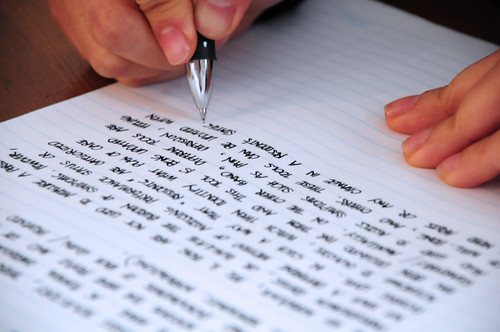
I can’t count how many times I’ve started writing a story and realized that it just wasn’t going to work. My first instinct is to delete everything I’ve worked on and start from scratch, but every time I get this inclination another, softer, voice tells me to go to the beginning and just press “Enter” enough times so that I can’t see the part that isn’t working. This process usually happens several times before the actual story even begins, if it begins at all, and once the story is complete I sometimes realize that the beginning I ended up with shouldn’t be the beginning at all. Maybe the beginning is somewhere in the middle. Maybe it is at the end. Maybe the real beginnings was one of the beginnings that I begun with. 

This is why I never throw away a beginning. Oftentimes, I find that unused beginnings have their place somewhere else--either in the story I am currently writing or one that I will write in the future. This same thought process applies not only to beginnings of stories, but to beginnings of chapters, paragraphs and even sentences. I never know when I’ll need them. So, what can I do with these beginnings in the meantime?

My solution is to save them, literally, in a file on my desktop, so that I can use them later. This file can be brought up whenever I really can’t seem to get a handle on the story I want to write. They provide me with a source of inspiration, or in many cases actual words, sentences, and paragraphs of material to pull from. The best part is that whenever I need to use this file it is often because I have other beginnings that aren’t working for that particular piece. In effect, for every one beginning taken, two are given and my bank of beginnings grows.

It is very easy to get frustrated when things aren’t going your way. There are times when I spend hours trying to make a story work until I realize that it just may not be time for that story yet. One of the favorite stories I have ever written, Heavy, was created from a beginning that was written a year prior. The beginning itself was only two paragraphs, but the story ended up being fifteen pages and I think it may have gotten me into graduate school. So, you never really know. Maybe you are reading something that you have written and thinking that it is awful--cut and paste it into a different file and save it. When your fresh eyes see it some time later, you may feel differently. It could even become a part of your favorite work, whether it be beginning, middle, or end.